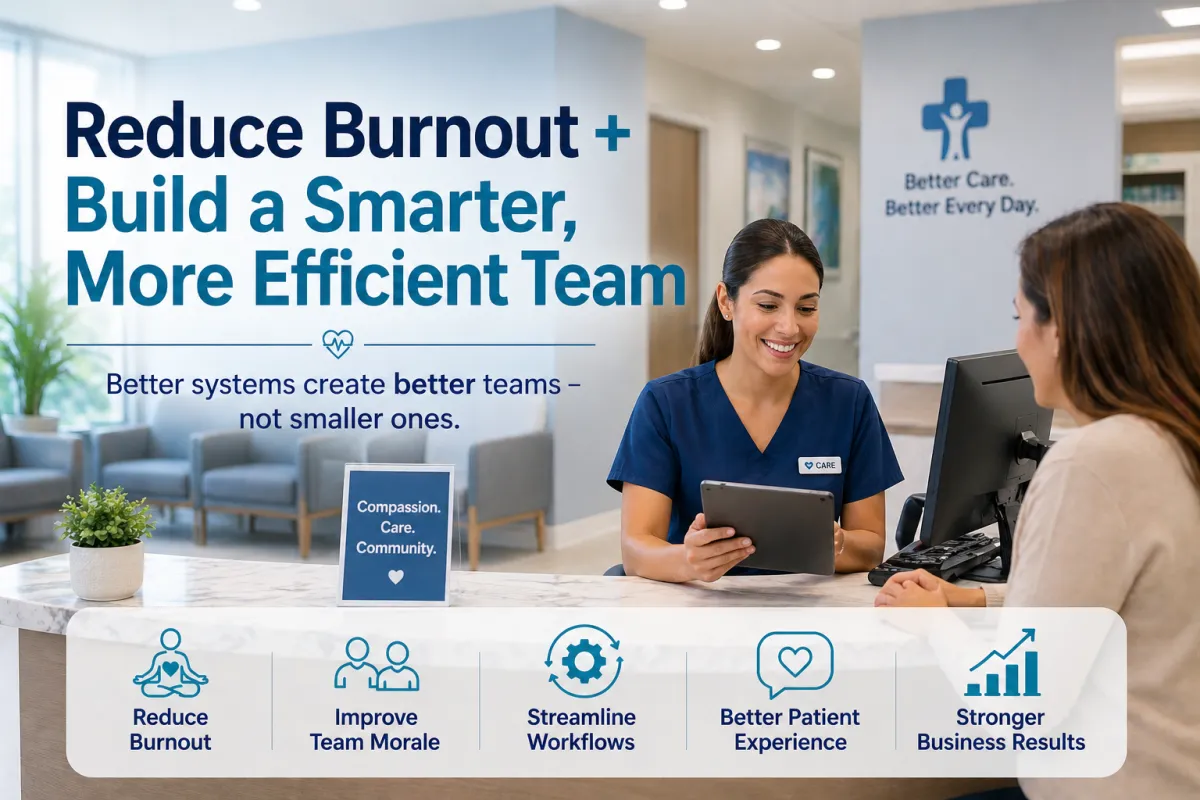
Reduce Burnout + Build a Smarter, More Efficient Team: Why Better Systems Matter in Healthcare
Healthcare teams are carrying more than ever.
From answering phones and managing appointments to handling patient questions, insurance details, refill requests, follow-ups, and administrative tasks, the front desk and support staff are often the heartbeat of a healthcare business. Whether you run a pharmacy, medspa, dental office, chiropractic clinic, wellness center, or medical practice, your team is expected to deliver excellent service while juggling constant interruptions.
The result? Burnout.
But here’s the good news: burnout is not always a staffing problem. Often, it is a systems problem.
When your team is overwhelmed, the answer is not necessarily to replace people or ask them to “do more with less.” The smarter solution is to build better workflows, use technology where it makes sense, and allow your staff to focus on the work that truly requires a human touch.
Better systems create better teams — not smaller ones.
And in today’s healthcare landscape, that is a long-term business advantage.
Why Staff Burnout Happens in Healthcare Businesses
Burnout can show up quietly at first.
Maybe your front desk team starts missing calls. Maybe response times get slower. Maybe patients complain about feeling rushed. Maybe your staff seems less engaged, more stressed, or constantly behind.
In many healthcare businesses, burnout is caused by repetitive administrative pressure, including:
Too many phone calls
Repeated appointment questions
Manual scheduling tasks
Missed follow-ups
Insurance or intake confusion
Constant interruptions
Lack of clear processes
Pressure to serve both in-person and online patients at the same time
Your team may be capable, caring, and committed — but without the right systems, even the best employees can become overwhelmed.
The Front Desk Should Not Carry the Entire Patient Experience Alone
For many healthcare businesses, the front desk is expected to be everywhere at once.
They greet patients, answer phones, respond to emails, schedule appointments, handle walk-ins, update records, confirm visits, manage payments, and answer the same common questions over and over.
That is not sustainable.
When your front desk is overloaded, it affects:
Patient experience
Staff morale
Scheduling accuracy
Response times
Online reviews
Revenue opportunities
Team retention
A stressed front desk can create a stressed patient experience.
But when your systems support your staff, your team can provide better in-person care, better communication, and better service.
How Smarter Systems Reduce Burnout
Operational efficiency does not mean removing the human connection. It means protecting it.
Smarter systems help automate or simplify repetitive tasks so your staff can focus on the moments that matter most.
Examples include:
Automated appointment reminders
Missed call text-back systems
Online booking tools
AI chat support for common questions
Digital intake forms
Review request automation
Follow-up campaigns
CRM workflows
Patient reactivation campaigns
Internal task reminders
These tools do not replace your people. They reduce the unnecessary pressure placed on them.
When routine questions and reminders are handled automatically, staff members have more time and energy for patients who need real human attention.
AI + Human Touch: The Hybrid Model That Works
The future is not AI versus your staff.
The future is AI working with your staff.
A hybrid model allows healthcare businesses to combine automation with genuine human care. AI can handle simple, repetitive, or after-hours communication, while your team focuses on personal service, problem-solving, and in-person patient relationships.
For example:
AI can answer frequently asked questions.
Your staff can help patients with sensitive concerns.
Automation can send appointment reminders.
Your team can create a warm welcome at the visit.
Digital systems can organize leads and follow-ups.
Your staff can build trust and loyalty.
This creates a better patient experience and a healthier work environment for your team.
Better Workflows Improve Morale
When employees feel like they are constantly behind, morale suffers.
But when staff members have clear systems, organized communication, and fewer repetitive tasks, they feel more confident and supported.
Better workflows can help your team:
Feel less reactive
Stay organized
Reduce daily stress
Communicate more clearly
Serve patients more calmly
Avoid unnecessary mistakes
Focus on higher-value work
Morale improves when people feel equipped to do their jobs well.
And when your team feels better, your patients can feel the difference.
Operational Efficiency Is a Business Advantage
Efficiency is not just about saving time. It is about building a stronger business.
When your healthcare business has better systems, you can:
Capture more leads
Reduce missed calls
Improve patient follow-up
Increase bookings
Build stronger patient relationships
Improve reviews
Retain staff longer
Create a more consistent patient experience
In a competitive healthcare market, the businesses that thrive are not always the ones with the biggest teams. They are often the ones with the smartest systems.
A well-supported team can serve more patients without feeling stretched thin.
Practical Ways to Start Building a Smarter Team
You do not need to overhaul everything overnight.
Start with the biggest stress points in your current workflow.
Ask your team:
What tasks feel repetitive?
Where do patients get stuck?
What questions are asked most often?
Where are calls or leads being missed?
What takes the most time each day?
Which tasks could be automated or simplified?
Then begin with one or two improvements.
For many healthcare businesses, the easiest starting points are:
Missed call text-back automation
Online appointment booking
Automated reminders
Google Business Profile messaging
Review request workflows
Lead follow-up systems
Website chat tools
Small changes can create major relief for your staff.
Better Systems Create Better Teams — Not Smaller Ones
There is a common fear that automation means replacing people.
But in healthcare, the best use of AI and automation is not to remove the human element. It is to protect it.
Patients still want kindness. They still want reassurance. They still want to feel seen, heard, and cared for.
Your staff provides that.
Technology simply helps remove the friction that gets in the way.
When AI and automation support your team, your staff can spend less time chasing tasks and more time building relationships.
That is how better systems create better teams.
SEO Tips for Healthcare Businesses
To make this topic work harder online, consider using phrases like:
“reduce front desk burnout”
“healthcare workflow automation”
“AI for healthcare practices”
“medical office efficiency”
“improve healthcare staff morale”
“AI and human touch in healthcare”
Use these keywords in:
Blog titles
Website service pages
Google Business Profile posts
Social captions
Image alt text
Meta descriptions
This helps your content reach healthcare business owners and practice managers searching for better ways to run their operations.
Final Thoughts
Burnout is not just a people problem. It is often a process problem.
When your staff is overwhelmed, your business does not need less humanity. It needs better support.
Smarter systems allow your team to breathe, focus, and provide better care. They improve workflow, morale, patient experience, and long-term business growth.
The future isn’t AI vs your staff — it’s AI working with your staff.
Want to try our Digital Receptionist to help your front desk or missed call issues?
Click here for to see HOW it can WORK for your Business!
https://bsammarketing.com/digital-receptionist
Book your strategy session below and let's set you up to get a FREE competitor's analysis or a personal digital audit of your business! (valued @ $200):
https://api.leadconnectorhq.com/widget/bookings/discoverywithalicia
