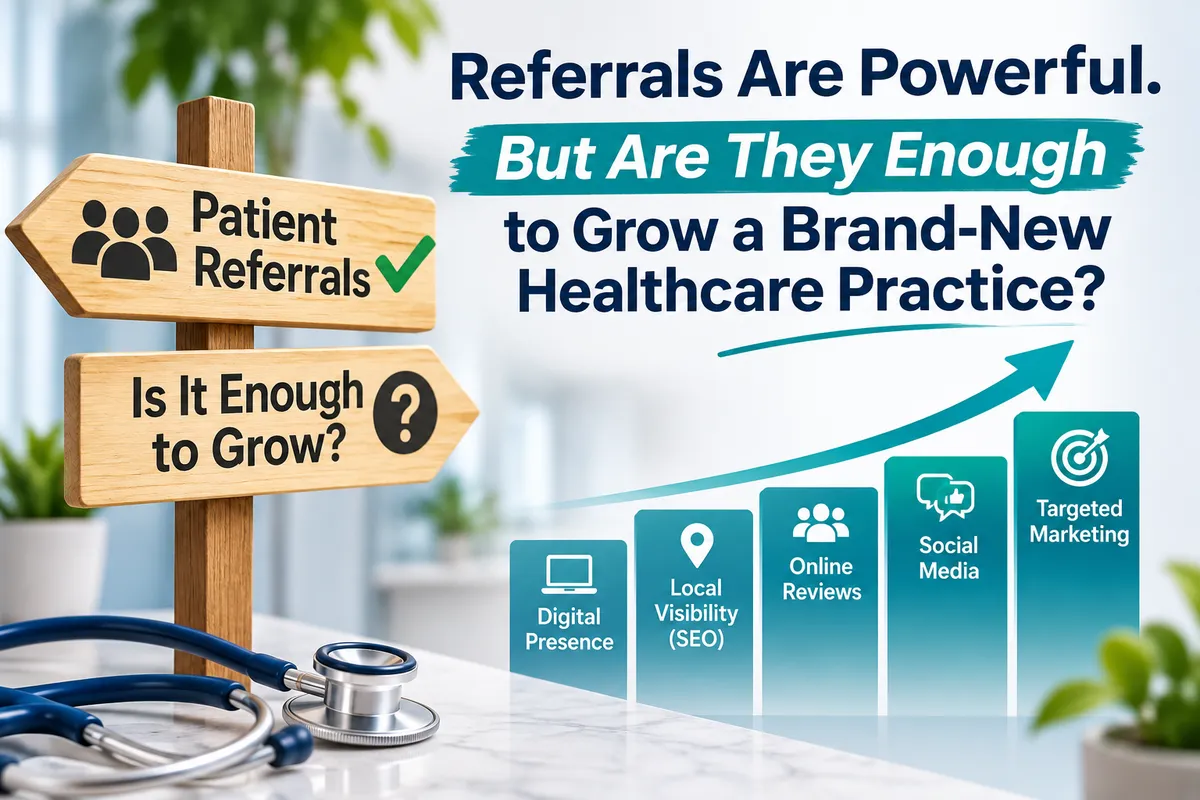
Referrals Are Powerful. But Are They Enough to Grow a Brand-New Healthcare Practice?
“I’m Going to Grow My Practice Through Referrals.”
It's one of the first strategies many healthcare entrepreneurs consider when opening a new business.
And you know what… it makes sense. We’ve spoken to plenty of practices that have said this before.
Healthcare has always been relationship-driven.
A physician recommends a specialist. A patient tells a friend about an excellent physical therapist. A family member recommends their pharmacist. Someone in a local Facebook group asks for a dentist, chiropractor, medspa, or healthcare provider, and neighbors begin sharing names.
Those recommendations can be incredibly valuable.
So when a new practice owner says:
“I'm going to build my business through referrals,”
our response isn't:
“Don't do that.”
It's:
“Absolutely. But what else are we doing?”
Because referrals are powerful, but relying exclusively on them can create an unpredictable patient acquisition system, especially for a brand-new healthcare business that hasn't yet had time to build a large referral network.
In the past weeks of our Invest Before You Open series, we've discussed budgeting for growth, investing startup capital strategically, and deciding whether to manage marketing yourself or subcontract it to professionals.
Now let's address another important question:
Where are your patients actually going to come from?
1. Referrals Should Absolutely Be Part of Your Strategy
Let's start by giving referrals the credit they deserve.
A recommendation from someone a prospective patient trusts can carry tremendous weight.
In healthcare especially, people often want reassurance before selecting a provider.
They may ask:
Friends and family.
Their primary care physician.
Other healthcare professionals.
Coworkers.
Community groups.
Local social media groups.
Existing patients.
That's why referral relationships should be intentionally developed.
A new healthcare entrepreneur may benefit from introducing the practice to nearby providers, connecting with community organizations, participating in appropriate professional networks, and delivering an experience that patients naturally want to recommend.
Referral marketing isn't outdated.
But there's an important limitation.
You don't control when somebody decides to refer someone to you.
And when you're opening a new business, you may not yet have enough relationships or existing patients to generate the volume you need.
2. The New-Practice Referral Problem
Imagine opening your practice on Monday.
Your monthly expenses have already begun.
You have:
Rent.
Payroll.
Insurance.
Software.
Utilities.
Inventory.
Loan payments.
Marketing expenses.
And dozens of other operational costs.
But your referral network is only beginning to develop.
You meet three physicians this month.
You attend a networking event.
You introduce yourself to several community organizations.
You hand out business cards.
Those efforts may eventually produce meaningful relationships.
But how quickly?
And how consistently?
That's the challenge.
Referral relationships usually need time to develop.
Your business expenses don't necessarily wait for them.
This is why we encourage healthcare startups to think in terms of multiple patient acquisition channels rather than one.
3. “I'll Rent a Table at a Health Fair.”
Health fairs, community festivals, senior events, wellness expos, and local business events can be excellent opportunities.
You can:
Introduce yourself personally.
Explain your services.
Meet community leaders.
Develop professional relationships.
Collect appropriate contact information with consent.
Increase local brand recognition.
Put a human face behind your new business.
BSAM isn't suggesting you stop doing any of those things.
Instead, ask:
What happens after the event?
Suppose you spend $500 on:
Vendor registration.
Printed materials.
Promotional items.
Signage.
Staff time.
Transportation and setup.
You speak with 75 people.
That's potentially valuable.
But how are you measuring what happened next?
Did anyone visit your website?
Did they follow your social media accounts?
Did they request an appointment?
Did they join an appropriate email list?
Did they eventually become a patient or customer?
Did the event produce referral relationships?
Without a system for following and measuring those interactions, it becomes difficult to determine the business impact of the event.
The event shouldn't necessarily be the entire marketing strategy. It can be the beginning of a larger marketing journey.
4. Your Offline Marketing and Digital Marketing Should Work Together
Imagine someone meets you at a community health fair.
You have a great conversation.
They take your business card.
Two weeks later, they need the service you provide.
What are they likely to do?
There's a good chance they'll search for your business online.
Now imagine what they find:
A professional website.
An optimized Google Business Profile.
Helpful educational content.
Current business information.
Appropriate reviews.
Clear descriptions of your services.
An easy way to contact your office or request an appointment.
Suddenly, the five-minute conversation you had at a health fair is reinforced by an entire digital presence.
Now consider the opposite.
They search for your business and find an incomplete Google profile, an outdated website, inconsistent information, or almost nothing at all.
That offline referral suddenly has much less digital reinforcement.
Your online presence doesn't replace community relationships. It strengthens them.
5. Referrals Have Gone Digital
Here's something else healthcare business owners should recognize:
Even when someone receives a personal recommendation, they may still research the business online before contacting it.
A referral might sound like:
“My friend told me about this physical therapist.”
The next step may be:
Google the practice.
A physician might recommend a specialist.
The patient may still look at the specialist's website.
Someone might recommend an independent pharmacy.
The customer may still check its hours, location, reviews, and services online.
This means your website, Google Business Profile, online reputation, and search visibility can influence people who were already referred to you.
Digital marketing isn't always responsible for creating the initial awareness.
Sometimes its role is helping validate the decision.
That's why the conversation shouldn't be:
Referrals OR digital marketing?
It should be:
How can referrals AND digital marketing work together?
6. What About Word of Mouth?
Word of mouth is one of the strongest forms of marketing a healthcare business can earn.
But there's an important word in that sentence:
Earn.
You can't simply turn on word-of-mouth marketing on opening day.
It develops from experiences.
Patients need to:
Discover you.
Choose you.
Interact with your team.
Receive an excellent experience.
Develop trust.
And eventually recommend you.
For an established practice with hundreds or thousands of satisfied patients, word of mouth can become a powerful growth engine.
A brand-new business doesn't have that history yet.
Digital marketing can help create some of the initial opportunities from which future word of mouth develops.
In other words:
Marketing can help introduce patients to your business. Your patient experience gives them a reason to tell someone else about it.
7. What Digital Marketing Adds to the Equation
Let's say you're actively networking, developing professional relationships, and participating in community events.
Excellent.
Now layer digital marketing on top of those activities.
Local Search Visibility
When people search for relevant services nearby, your practice has an opportunity to appear.
Google Business Profile
Potential patients can find your location, hours, photos, services, contact information, and other useful details.
Educational Content
Blogs, social posts, and educational resources can demonstrate your expertise and answer common questions before someone contacts your office.
Paid Advertising
Appropriately targeted campaigns can introduce your business to relevant audiences rather than waiting for someone else to refer them.
Reputation Management
Reviews can provide additional reassurance to people researching your business.
CRM & Automation
Inquiry tracking and appropriate follow-up systems can help your team manage opportunities generated both online and offline.
The objective isn't to replace human relationships with technology.
It's to create a broader system for attracting and managing opportunities.
8. Let's Compare Two Hypothetical Startup Strategies
Consider two new healthcare businesses.
Practice A: Referral-Only Strategy
The owner:
Visits nearby healthcare providers.
Attends networking meetings.
Participates in one community event each month.
Asks friends and family to spread the word.
Posts occasionally on social media.
Those activities may produce patients.
But acquisition is largely dependent on other people initiating the next step.
Practice B: Integrated Strategy
This owner does everything Practice A does.
But the business also has:
A professionally established website.
An optimized Google Business Profile.
Local SEO.
Consistent educational content.
A controlled advertising campaign.
Inquiry tracking.
CRM and appropriate follow-up automation.
Practice B hasn't abandoned relationship marketing.
It has multiplied the number of ways people can discover and interact with the business.
That's the distinction.
9. Think in Terms of a Patient Acquisition Portfolio
There's a useful principle from financial planning that also applies conceptually to marketing:
Diversification.
Depending entirely on one source creates vulnerability.
If nearly all of your patients come from one referral partner, what happens if that relationship changes?
If all of your leads come from paid advertising, what happens if advertising costs rise dramatically?
If all your growth comes from Instagram, what happens when reach declines?
A healthier acquisition strategy may include several channels:
Acquisition Channel | Primary Role |
Professional referrals | Trust and clinical relationships |
Patient referrals | Word of mouth |
Community events | Local visibility and relationships |
Google/local SEO | Capture active local searches |
Paid advertising | Generate targeted awareness/inquiries |
Content/social media | Education and familiarity |
Email/CRM | Nurture and follow-up |
Reviews/reputation | Trust reinforcement |
Not every practice needs every channel.
The appropriate mix depends on specialty, location, budget, audience, and business model.
But relying entirely on one channel creates unnecessary dependence.
10. Measure Your Community Marketing Too
One of the advantages of digital advertising is measurability.
You can often track metrics such as:
Traffic.
Calls.
Form submissions.
Qualified inquiries.
Appointments.
Acquisition costs.
But offline marketing can be measured too.
Suppose you're attending a health fair.
Create a trackable process.
You might use:
A dedicated QR code.
A campaign-specific landing page.
A trackable phone number, where appropriate.
A unique offer or event identifier.
CRM source tracking.
A specific appointment-request form.
Then record the source.
Instead of saying:
“The health fair seemed pretty successful,”
you can eventually ask:
“How many inquiries, appointments, or business relationships resulted from that event?”
That's a much more useful business question.
11. Don't Forget About the Follow-Up
Whether an inquiry comes from Google Ads, a physician referral, Facebook, a health fair, or a community partnership, something still needs to happen after the initial contact.
Someone has to respond.
That's where the systems we've discussed throughout this series become important.
Your CRM can help organize opportunities by source.
Appropriate automation may support:
New inquiry acknowledgment.
Internal lead notifications.
Missed-call responses.
Appointment-request follow-up.
Reminder workflows.
Appropriate review requests.
Healthcare businesses must ensure that marketing and communication systems comply with applicable privacy, consent, professional, and platform requirements, including HIPAA where relevant.
The goal isn't to automate the relationship.
It's to make sure opportunities don't disappear because everyone assumed someone else followed up.
12. Where BSAM Fits Into the Strategy
This is exactly why BSAM Marketing approaches healthcare marketing as a connected system.
We're not suggesting that a digital campaign should replace your referral relationships.
Quite the opposite.
Keep building those relationships.
Go to community events.
Meet local business owners.
Develop partnerships.
Create an excellent patient experience.
Encourage appropriate word of mouth.
Then make those activities work harder by supporting them with a strong digital presence.
Depending on your business needs and selected services, BSAM can help coordinate:
Website & Digital Foundation
Helping prospective patients find useful information about your business.
Local SEO & Google Business Profile
Helping strengthen your visibility when people search locally.
Paid Advertising
Creating targeted campaigns when advertising makes sense for your business.
Content Marketing
Keeping your business visible and educational between interactions.
CRM & Automation
Helping organize inquiries and appropriate follow-up.
Tracking & Strategy
Helping identify which channels are creating meaningful opportunities.
Instead of managing isolated marketing tactics, you begin building an acquisition ecosystem.
13. A Better Question Than “Do Referrals Work?”
The answer is yes.
Referrals work.
Community events can work.
Networking can work.
Digital advertising can work.
SEO can work.
Social media can work.
The more useful questions are:
Which channels work for YOUR business?
How much does each one cost?
Which channels generate qualified opportunities?
Which ones ultimately contribute to booked appointments and revenue?
And how can they reinforce each other?
Those are the questions that turn marketing from a collection of activities into a business strategy.
Final Thoughts: Don't Choose Between Community and Digital. Connect Them.
Healthcare will always be personal.
Trust matters.
Relationships matter.
Community involvement matters.
Referrals matter.
None of that disappears because digital marketing exists.
But the way patients discover and evaluate healthcare businesses has expanded.
Someone can hear about your practice from a physician, see you at a health fair, encounter your social content, search for you on Google, read reviews, visit your website, and then contact your office.
Which one generated the patient?
Potentially all of them contributed.
That's why new healthcare businesses shouldn't think of referral marketing and digital marketing as competing strategies.
The stronger opportunity is often connecting them.
At BSAM Marketing, we help healthcare entrepreneurs create coordinated marketing systems that support both community relationships and digital patient acquisition, without leaving the business owner responsible for figuring out every piece alone.
Your next patient might come from a referral. Or Google. Or a community event. Why build a business that can only be discovered one way?
Book your strategy session below and let's set you up to get a FREE competitor's analysis or a personal digital audit of your business! (valued @ $200):
https://api.leadconnectorhq.com/widget/bookings/discoverywithalicia
References & Additional Reading
U.S. Small Business Administration — Marketing and Sales
https://www.sba.gov/business-guide/manage-your-business/marketing-sales
Google Business Profile Help
https://support.google.com/business/
U.S. Department of Health & Human Services — HIPAA Privacy Rule and Marketing
https://www.hhs.gov/hipaa/for-professionals/privacy/guidance/marketing/index.html
Marketing results vary by business, specialty, market, budget, competition, execution, and other factors. Examples are educational and are not guarantees of patient volume or financial results.
