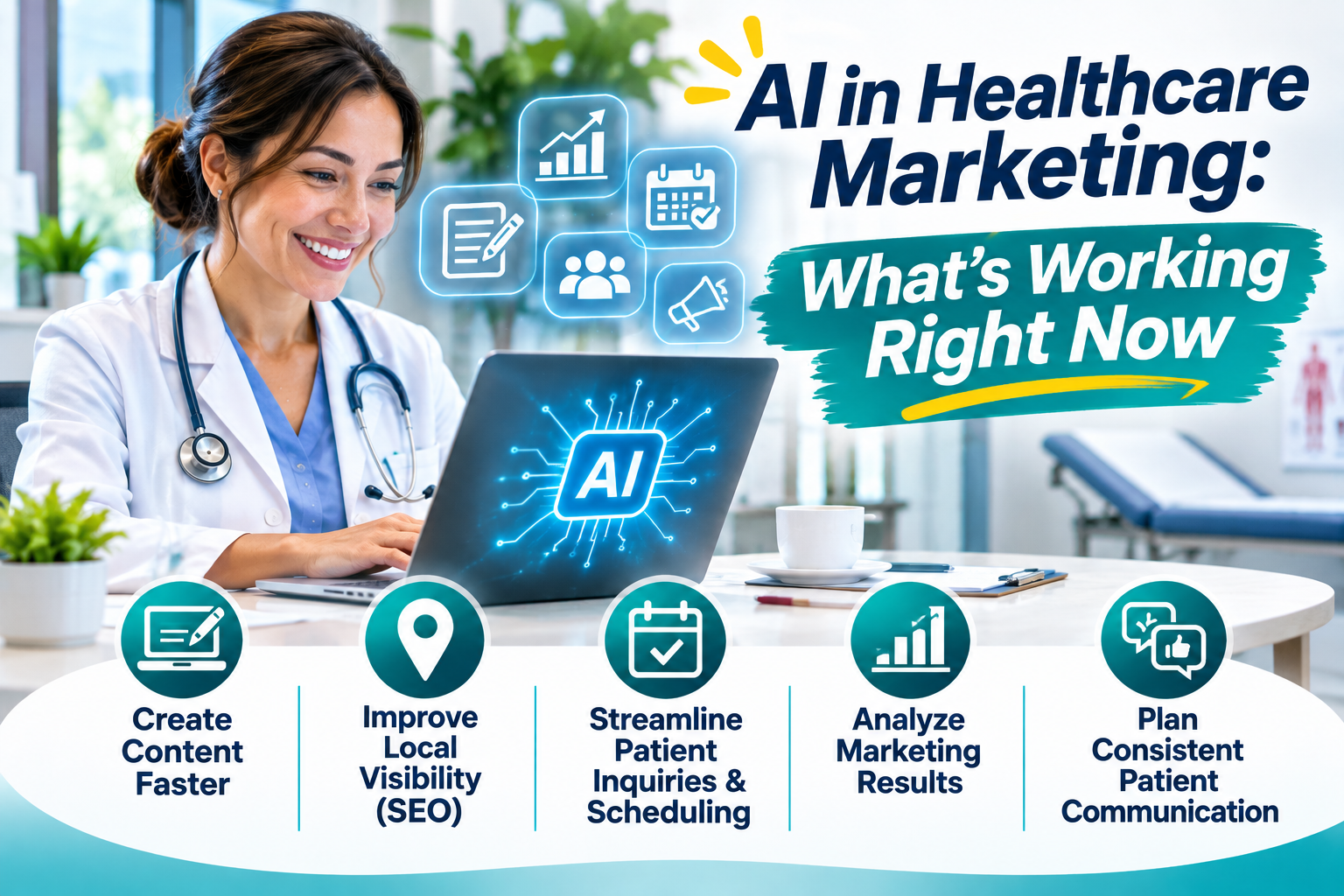
AI in Healthcare Marketing: What's Working Right Now
Introduction: AI Is Changing Healthcare Marketing, but What Actually Works?
Artificial intelligence is everywhere.
From automated customer service to content creation, search engines, and marketing analytics, AI is transforming how businesses communicate with their audiences.
But for independent pharmacies, dental offices, medical practices, medspas, chiropractic clinics, and wellness businesses, one important question remains:
Which AI marketing strategies are actually worth your time and investment?
The answer isn't necessarily the newest or most complicated technology.
It's finding practical ways to save time, improve consistency, reach the right audience, and support better patient experiences.
For smaller healthcare businesses, this matters.
Many owners and practice managers are already balancing patient care, staffing, operations, billing, and community relationships.
Marketing often becomes another responsibility competing for attention.
AI can help reduce some of that workload, but it works best when paired with human expertise, accurate information, and a clear strategy.
Let's explore the most practical AI marketing applications worth considering as 2026 comes to a close.
1. AI-Assisted Content Creation
One of the most accessible uses of AI in healthcare marketing is content development.
Healthcare businesses need consistent communication across multiple channels, including:
Website blogs.
Google Business Profile updates.
Facebook and Instagram.
LinkedIn.
Educational email newsletters.
Service descriptions.
Frequently asked questions.
Creating content for every platform can take hours.
AI tools can help generate initial drafts, organize ideas, repurpose existing educational materials, and develop content calendars.
For example, an independent pharmacy might use AI to outline an educational article about medication organization during holiday travel.
That article could then become a Google Business Profile update, a short Facebook post, an Instagram carousel, and an email newsletter.
Instead of developing five unrelated pieces of content, the business starts with one carefully reviewed educational resource.
What's working: Using AI to accelerate drafting and repurposing while keeping a qualified human responsible for final review.
What to avoid: Publishing unverified medical claims, invented statistics, or generic articles that don't reflect your services.
Healthcare content should always be accurate, clear, and appropriate for the audience.
2. AI for Local SEO and Online Visibility
When prospective patients search for a nearby pharmacy, dentist, chiropractor, or medical provider, your business needs to be discoverable.
AI can support local search engine optimization by helping your team identify relevant topics and organize website content.
Practical applications include:
Brainstorming location-specific blog topics.
Drafting descriptions of actual services.
Identifying common questions patients may search for.
Improving page headings and meta descriptions.
Organizing internal links between related pages.
Creating content outlines for service-area pages.
For example, a dental practice could develop a helpful FAQ explaining what new patients should expect at their first appointment.
A pharmacy could create a page explaining its medication synchronization services, if offered.
A medspa might develop educational content about its consultation process.
The key is to make content useful and factually accurate.
AI-generated pages stuffed with keywords or duplicated across dozens of locations are not a sustainable strategy.
What's working: Combining AI-assisted content research with genuine local expertise and useful website information.
Your actual business information, services, location, and patient experience should remain central.
3. Smarter Appointment and Inquiry Workflows
Responding to inquiries promptly is an important part of the patient experience.
A prospective patient may visit your website after business hours, request information, or want to know how to schedule an appointment.
AI-assisted workflows and conventional automation can help businesses organize these interactions.
Examples include:
Routing website inquiries to the correct team.
Providing approved answers to general business questions.
Directing visitors to online scheduling.
Organizing nonclinical contact requests.
Supporting appointment reminder workflows.
Alerting staff when a response is needed.
A dental office, for instance, could use an approved website assistant to explain office hours, provide parking information, and direct visitors to the scheduling page.
A pharmacy might offer general information about its hours, location, or publicly listed services.
These workflows should not be mistaken for clinical advice.
Any question involving symptoms, medications, treatment decisions, or urgent care should be handled through appropriate clinical channels.
What's working: Automating repetitive administrative steps while keeping clinical decisions and sensitive conversations with qualified professionals.
4. AI-Assisted Marketing Analytics
Healthcare business owners often know they need to market consistently but struggle to determine which efforts are producing results.
AI-assisted analytics can help summarize trends across approved, appropriately configured marketing systems.
For example, a practice might examine:
Website traffic trends.
Appointment inquiry volume.
Advertising campaign performance.
Email engagement.
Search visibility.
Social media engagement.
Marketing costs per qualified inquiry.
Instead of looking at disconnected reports, owners can develop a clearer picture of which marketing channels deserve attention.
Suppose a physical therapy practice discovers that its educational website content consistently generates relevant appointment inquiries, while a paid campaign produces traffic but few inquiries.
That insight could help the practice reconsider its budget.
However, analytics tools must be configured to avoid inappropriate collection or disclosure of patient information.
What's working: Using AI to summarize approved marketing data and support human decision-making.
AI doesn't eliminate the need to understand the numbers. It helps teams interpret them more efficiently.
5. AI for Patient-Friendly Educational Communication
Healthcare professionals understand that many patients find medical terminology confusing.
AI can help teams draft educational materials in clearer, more accessible language.
For example, a practice could use AI to simplify a general explanation of its appointment process or prepare multiple reading-level versions of an educational handout.
A pharmacy could create a general checklist of questions customers may want to ask their pharmacist.
A chiropractor might prepare a plain-language explanation of what to expect during an initial consultation.
These materials should be reviewed by an appropriately qualified professional before publication.
AI-generated educational content can contain errors, omit important context, or oversimplify complex health information.
What's working: Using AI as an editorial assistant, not as an independent source of medical guidance.
Clear communication can support patient understanding while reinforcing your brand's commitment to education.
6. AI-Assisted Social Media Planning
Many healthcare businesses struggle with social media consistency.
One week, they post several times. The next, they're too busy to post anything.
AI can help organize a manageable publishing schedule.
Consider a simple monthly content structure:
Week 1: Patient education.
Week 2: Staff or community spotlight.
Week 3: Frequently asked questions.
Week 4: Service awareness or seasonal wellness information.
AI can help brainstorm topics, draft captions, suggest creative concepts, and adapt approved messages for different platforms.
However, a successful healthcare social media strategy still needs authentic photos, genuine expertise, and meaningful local relevance.
Your patients want to see the real people behind your business, not an endless stream of generic AI-generated graphics.
What's working: Using AI for consistency and efficiency while keeping your brand voice personal.
7. Reputation Management With Human Oversight
Online reputation is especially important for healthcare businesses.
AI can assist by organizing publicly available review themes, drafting potential responses, and identifying recurring operational concerns.
For example, if multiple reviews mention difficulty reaching the front desk, that may indicate an opportunity to improve communication.
If patients frequently praise the friendliness of the staff, your practice might reinforce that strength through appropriate team-focused marketing.
However, AI-generated review responses should never be published automatically without careful oversight.
For HIPAA-covered organizations, publicly acknowledging that someone is a patient or discussing their care can create privacy concerns.
A safe, general response might be:
"Thank you for sharing your feedback. We value feedback from our community and encourage anyone with questions or concerns to contact our office directly."
Responses should follow your organization's privacy policies and legal requirements.
What's working: Using AI to identify broad feedback trends while maintaining human control over public communications.
8. Where AI Marketing Can Go Wrong
AI offers meaningful opportunities, but it also introduces risks.
Healthcare businesses should be particularly cautious about:
Patient privacy: Never paste patient records, identifiable health details, or other protected information into an unapproved AI platform.
Inaccurate content: AI can generate convincing statements that are factually wrong.
Generic branding: Overreliance on AI can make your marketing sound indistinguishable from competitors.
Automated clinical advice: General-purpose marketing tools should not diagnose conditions, recommend treatment, or replace licensed healthcare professionals.
Unverified performance claims: AI vendors may advertise impressive results that don't necessarily apply to your business.
Hidden costs: Subscriptions, integration fees, training, and ongoing oversight all affect return on investment.
For HIPAA-covered organizations, vendor arrangements and permitted data uses need careful review. A business associate agreement may be required when a vendor handles protected health information on the organization's behalf.
The safest approach is to start with low-risk marketing tasks that do not require sensitive patient information.
9. How to Start Using AI Without Overcomplicating Your Business
You don't need a large technology budget to begin exploring AI marketing.
Start with one manageable workflow.
Step 1: Identify a repetitive marketing task
Choose something your team already does regularly, such as drafting social media captions or preparing monthly content calendars.
Step 2: Establish privacy and quality rules
Decide what information can be entered into an AI tool and who must approve the output.
Step 3: Test a small project
For example, use AI to create first drafts of four educational social posts.
Step 4: Review the results
Measure time saved, content quality, engagement, and any additional editing required.
Step 5: Expand carefully
If the workflow provides value, consider another application.
Avoid purchasing several AI platforms before identifying the actual business problem each one solves.
10. Make AI Part of Your 2027 Marketing Strategy
As you plan for 2027, consider where AI could improve your marketing operations.
Ask yourself:
Which marketing activities take the most staff time?
Where are we inconsistent?
Which tasks can be automated safely?
Which activities still require direct human involvement?
How will we measure return on investment?
Do our tools meet our privacy and security requirements?
The strongest AI strategy isn't necessarily the one using the most technology.
It's the one that supports your business goals without sacrificing patient trust.
Final Thoughts: AI Should Support Your Healthcare Brand, Not Replace Its Human Connection
AI is creating new opportunities for healthcare businesses to communicate more efficiently, organize their marketing, and improve their digital presence.
But the most valuable part of your brand is still human.
Patients choose healthcare professionals because they want expertise, understanding, compassion, and trust.
AI can help your team create content, manage workflows, and analyze marketing performance.
It cannot replace the relationships that make your business special.
As 2027 approaches, now is a smart time to evaluate which AI tools deserve a place in your marketing strategy and which are simply unnecessary distractions.
Ready to Build a Smarter Healthcare Marketing Strategy?
At BSAM Marketing, we help healthcare businesses identify practical digital marketing opportunities that support visibility, engagement, and sustainable growth.
Book your strategy session below and let's set you up to get a FREE competitor's analysis or a personal digital audit of your business! (valued @ $200):
https://api.leadconnectorhq.com/widget/bookings/discoverywithalicia
References and Further Reading
HHS: Summary of the HIPAA Privacy Rule — https://www.hhs.gov/hipaa/for-professionals/privacy/laws-regulations/
HHS: Collecting, Using, or Sharing Consumer Health Information — https://www.hhs.gov/hipaa/for-professionals/special-topics/hipaa-ftc-act/
National Institute of Standards and Technology: AI Risk Management Framework — https://www.nist.gov/itl/ai-risk-management-framework
