

See Our Latest Blogs
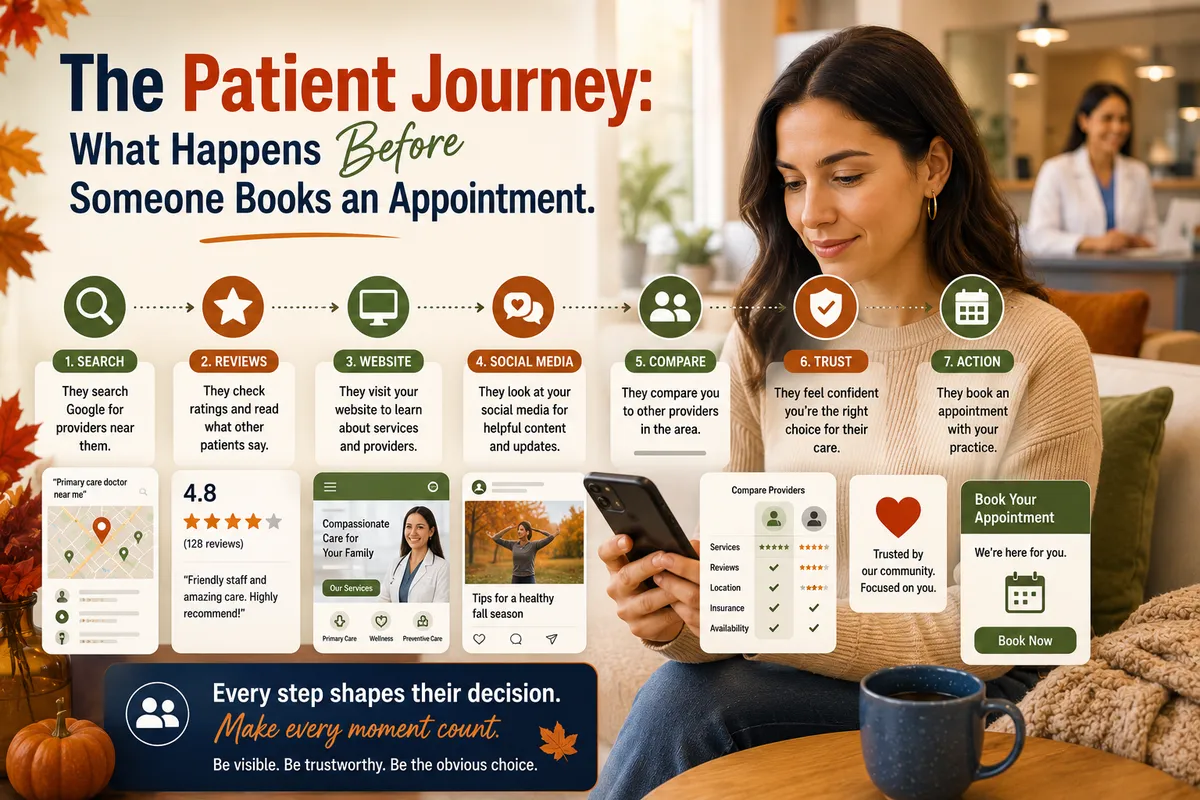
The Patient Journey: What Happens Before Someone Books an Appointment
A new patient books an appointment with your practice.
Success, right?
Absolutely, but that appointment didn't begin when the patient clicked the “Book Now” button.
It may have started days or even weeks earlier.
Maybe they searched Google for a provider near them. Perhaps they saw your practice mentioned on social media, drove past your office, received a recommendation from a friend, or noticed one of your ads.
Then the research began.
They checked your Google Business Profile. They read reviews. They visited your website. They looked at your services. They may have checked your social media accounts. They compared your practice with another provider.
Only after all those small interactions did they decide whether they trusted your business enough to call or book.
This process is known as the patient journey, and understanding it can transform how healthcare businesses approach digital marketing.
The Patient Journey Starts Before the Appointment
Healthcare businesses sometimes focus marketing efforts almost entirely on the final conversion:
Did someone book an appointment?
But that overlooks everything that happened beforehand.
The digital patient journey can look something like this:
Need → Search → Discovery → Research → Comparison → Trust → Action → Appointment
Every stage gives your practice an opportunity to either move a prospective patient closer to booking or unintentionally send them elsewhere.
Let's break down what happens.
Stage 1: A Patient Recognizes a Need
The journey usually starts with a problem, question, goal, or need.
Someone may realize:
They need a new primary care provider
They're experiencing discomfort and need a dentist
They want help managing chronic pain
They're looking for physical therapy
They're considering an aesthetic treatment
They need a nearby pharmacy
They want wellness support
They're searching for a healthcare specialist
At this stage, they may not know your business exists.
They're thinking about their need, not your brand.
This distinction matters.
Effective healthcare marketing starts by understanding the questions prospective patients are already asking.
Instead of creating content only about your practice, create content that addresses those needs.
For example, a physical therapy practice could publish educational content around common reasons people seek PT. A dental practice could answer frequently asked questions about preventive care or procedures. A pharmacy might explain services such as medication synchronization or delivery.
Helpful content allows your organization to become part of the patient's journey before they're ready to make a decision.
Stage 2: They Search for Options
Once someone decides to seek help, Google is often one of the places they turn.
Their searches may be simple:
“dentist near me”
“physical therapist near me”
“pharmacy near me”
“medspa near me”
“urgent care near me”
Or they may be more specific:
“chiropractor for back pain near me”
“dentist accepting new patients”
“physical therapy in [city]”
At this point, local SEO becomes critical.
Your website and Google Business Profile should clearly communicate:
What you do
Where you're located
Who you serve
How to contact you
Your hours
Your primary services
How to take the next step
If your competitors appear prominently and your practice doesn't, the patient journey may end before the prospective patient ever encounters your brand.
SEO Tip: Build your online presence around the way real patients search. Your city, service area, specialties, and core services should be clear to both search engines and visitors.
Stage 3: They Check Your Google Business Profile
Finding your name isn't the same as choosing you.
A prospective patient who discovers your practice through local search may immediately examine your Google Business Profile.
They may look at:
Your star rating
Recent reviews
Photos
Office hours
Location
Services
Website
Directions
Recent posts
Overall professionalism
Think of your Google Business Profile as a digital front door.
If the information is incomplete, outdated, or inconsistent, prospective patients may question whether the same lack of attention exists elsewhere in the business.
On the other hand, an accurate and active profile creates an immediate sense that your organization is accessible and engaged.
Stage 4: They Read Your Reviews
Reviews can become one of the most influential trust signals during the research stage.
Prospective patients aren't necessarily expecting perfection.
They're trying to understand what the experience may be like.
They might look for comments about:
Staff friendliness
Communication
Wait times
Professionalism
Convenience
Office environment
Ease of scheduling
Overall experience
They're also paying attention to how your organization responds.
Does your practice acknowledge feedback professionally?
Do responses sound caring and respectful?
Or are reviews being ignored?
Healthcare organizations should always protect patient privacy when responding publicly and avoid confirming someone's patient status or discussing health information.
The goal is to demonstrate professionalism without disclosing sensitive information.
Stage 5: They Visit Your Website
Now the prospective patient is interested enough to learn more.
This is where many healthcare organizations unintentionally create friction.
A beautiful website isn't enough.
Your website needs to answer questions quickly.
Within a short period of arriving, a visitor should understand:
Who are you?
What services do you offer?
Where are you located?
Why should I consider your practice?
What should I do next?
Make sure essential information isn't buried behind complicated menus or excessive text.
Your website should provide clear pathways to:
Service information
Provider information
Location and hours
Frequently asked questions
Contact information
Appointment requests or online booking, when available
And don't forget mobile users.
A patient researching your practice on a smartphone shouldn't have to zoom, hunt for buttons, or navigate a complicated form just to contact you.
Marketing Tip: Review your website as if you've never seen your business before. Better yet, ask someone unfamiliar with the site to find a specific service and book an appointment. Notice where they hesitate.
Those points of hesitation are opportunities for improvement.
Stage 6: They Look for Reasons to Trust You
Healthcare decisions are personal.
Prospective patients aren't simply purchasing a product. They're deciding who they may trust with an aspect of their health, wellness, appearance, recovery, or family's care.
Trust signals therefore matter throughout the patient journey.
These can include:
Professional provider biographies
Authentic staff photos
Educational content
Credentials and qualifications
Clear service descriptions
Patient reviews
Community involvement
Frequently asked questions
Professional branding
Consistent business information
Social media can contribute to this process as well.
A patient who finds an active social presence featuring staff introductions, educational posts, community involvement, and helpful information may feel more familiar with your organization before ever walking through the door.
That familiarity can reduce uncertainty.
Stage 7: They Compare You With Another Provider
Here's something healthcare businesses sometimes forget:
You're rarely being evaluated in isolation.
A prospective patient may have several browser tabs open.
Your practice.
A competitor.
Another competitor.
They're comparing experiences.
One website may have clearer information.
Another may have stronger reviews.
Another may offer convenient online scheduling.
Another may simply feel more welcoming.
This means your digital competitors aren't necessarily the largest healthcare organizations in your area.
They're the businesses that appear alongside you when patients search.
That's why competitor analysis can be valuable.
Look at:
Who ranks for your important searches
How many reviews competitors have
How frequently they post
How their websites are structured
Which services they emphasize
Whether they offer online booking
How clearly they communicate their value
You don't need to copy competitors.
You need to understand the digital environment in which patients are making decisions.
Stage 8: They're Ready to Book, Don't Make It Difficult
After all that research, your prospective patient is finally ready.
Now comes one of the most important moments in the journey.
Can they easily take action?
Your website should provide a clear next step, such as:
Book an Appointment
Request an Appointment
Call Our Office
Contact Us
Avoid forcing visitors to hunt for contact information.
Make important calls-to-action visible throughout the website, particularly on mobile devices and service pages.
Forms should also be as straightforward as possible.
Every unnecessary field creates another opportunity for someone to stop.
The easier the transition from “I'm interested” to “I've contacted the practice,” the better the patient experience.
Your Marketing Channels Should Work Together
The patient journey shows why digital marketing shouldn't operate as a collection of disconnected activities.
SEO brings someone to your practice.
Your Google Business Profile helps establish credibility.
Reviews strengthen trust.
Your website provides information.
Social media builds familiarity.
Educational content demonstrates expertise.
A clear call-to-action makes the next step easy.
Each component supports the others.
This is why focusing exclusively on one metric—such as social media followers—can give healthcare businesses an incomplete picture.
The bigger question is:
Does your overall digital presence help move the right people from discovery to action?
How to Evaluate Your Own Patient Journey
Try experiencing your practice exactly as a prospective patient would.
Search Google for one of your main services without using your business name.
Then ask:
Does your practice appear?
Is your Google Business Profile accurate?
Are your reviews recent?
Do your photos represent your organization well?
Does your website load quickly?
Can you immediately understand the services offered?
Is the website easy to navigate on mobile?
Can you find the appointment button?
Is the next step obvious?
Does the entire experience feel consistent and trustworthy?
If you find friction, confusion, or missing information, prospective patients probably do too.
Final Thoughts
An appointment isn't the beginning of the patient journey.
It's the result of everything that happened before it.
From the first Google search to the final booking button, every digital interaction influences how prospective patients perceive your organization.
Healthcare businesses that understand this can stop thinking about marketing as simply “getting more clicks” and start thinking about creating a better path from discovery to trust to action.
That path should be easy to find, easy to understand, and easy to navigate.
When your local SEO, Google Business Profile, website, reviews, content, social media, and appointment process work together, you're not simply promoting a healthcare business.
You're creating a better digital experience for the people trying to find it.
Want to know what prospective patients see when they search for your healthcare business—and how your digital presence compares with local competitors?
Book your strategy session below, and let's set you up to get a FREE competitor's analysis or a personal digital audit of your business! (valued @ $200):
https://api.leadconnectorhq.com/widget/bookings/discoverywithalicia

Our Philosophy
Our focus is to bridge the gap between health and medical companies and the people who need them most, ensuring that medical expertise reaches the right audience with clarity and trust. We believe that impactful communication in healthcare should be precise, ethical, and patient-centered just like medicine itself. By combining innovation with integrity, we create digital strategies that not only enhance visibility but also foster meaningful connections, empowering health and medical professionals and businesses to serve, educate, and heal more effectively.
Get In Touch
Email: alicia@bsammarketing.com
Address:
2933 Vauxhall Road, Suite 7 Vauxhall, NJ 07088
Assistance Hours
Mon – Fri 10:00am – 4:00pm
Sat - Sun – CLOSED
Phone Number:
(201) 254-3338


MARKETING FOR THE HEALTH AND MEDICAL SECTORS
Helping Healthcare Professionals and Agencies, MedTech, HealthTech, Biotech and Pharmaceutical companies simplify and deliver their message, increase visibility and scale their businesses.



© 2026 BSAM Marketing - All Rights Reserved