

See Our Latest Blogs
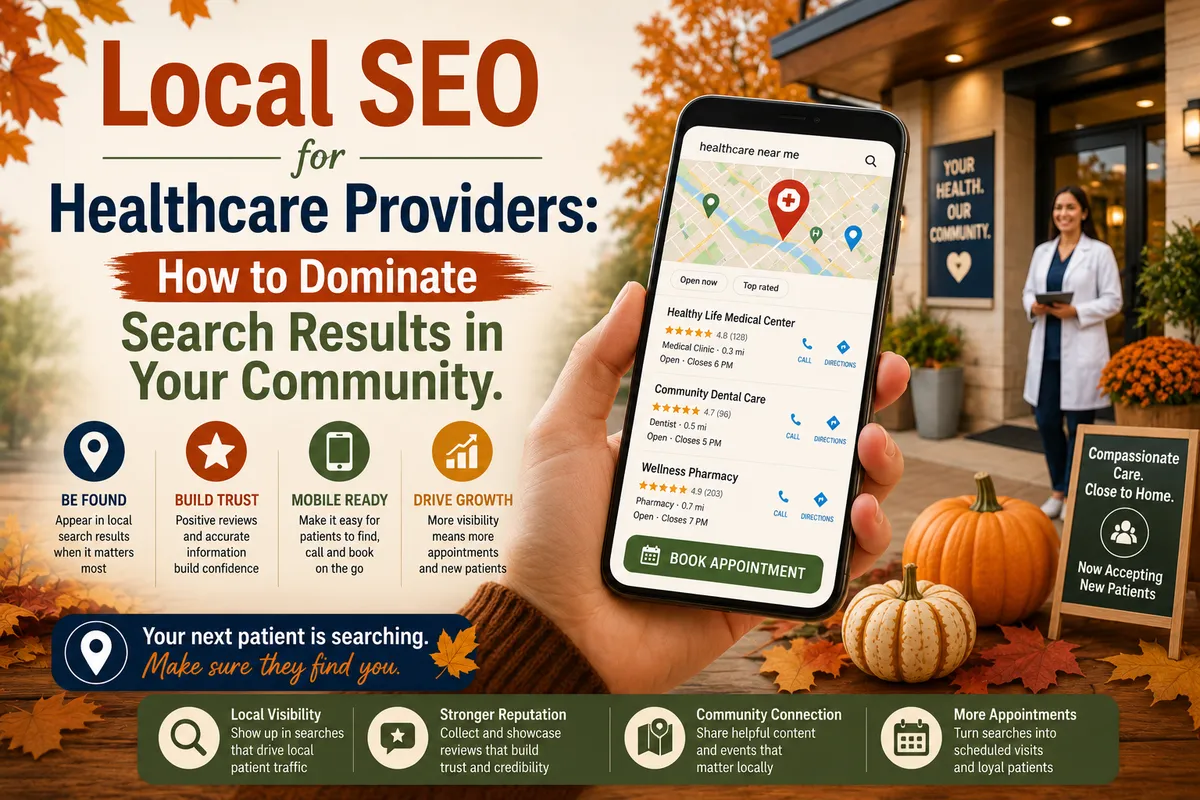
Local SEO for Healthcare Providers: How to Dominate Search Results in Your Community
When someone in your community needs a healthcare provider, where do they look first?
Increasingly, the answer is online.
A prospective patient may pull out their phone and search:
“dentist near me”
“pharmacy near me”
“physical therapist near me”
“medspa near me”
“chiropractor in [city]”
“primary care doctor near me”
The healthcare organizations that appear prominently in those local search results immediately gain an important advantage: visibility at the exact moment someone is looking for their services.
That's the power of local SEO.
Local search engine optimization helps healthcare businesses improve their visibility for searches connected to a specific geographic area. For independent practices competing with larger healthcare organizations, local SEO can be one of the most valuable parts of a digital marketing strategy.
You don't necessarily need to be the biggest healthcare organization in your market.
You need to make sure the right people can find you when they're searching.
Here's where to start.
1. Understand What Local SEO Means for Healthcare
Traditional SEO focuses broadly on helping websites appear in search engines.
Local SEO goes one step further by focusing on geographically relevant searches.
For example, someone searching “physical therapy” may receive broad informational results.
Someone searching “physical therapist near me” or “physical therapist in Newark NJ” is demonstrating much stronger local intent.
For healthcare businesses, these searches matter because services are often location-dependent.
A patient usually wants a provider who is reasonably close, trustworthy, convenient, and relevant to their specific need.
Local SEO helps connect that intent with your practice.
Depending on your organization, that may include optimizing your:
Google Business Profile
Website
Location pages
Service pages
Online directory listings
Reviews
Local content
Business information
The goal is to create a consistent digital footprint that helps search engines understand what you do, where you are, and who you serve.
2. Make Your Google Business Profile a Priority
For local healthcare searches, your Google Business Profile can be one of your most important digital assets.
Think of it as your practice's digital storefront.
Before a prospective patient ever reaches your website, they may see your:
Business name
Address
Phone number
Hours
Reviews
Photos
Services
Website link
Directions
Updates
An incomplete or outdated profile can create unnecessary friction.
Start by reviewing the basics.
Is your business information accurate?
Are your office hours current?
Is your primary category appropriate?
Have you added relevant services?
Are your photos recent and professional?
Are you posting useful updates?
Your profile should accurately reflect the real-world experience someone will have with your organization.
💡 Local SEO Tip: Don't create unnecessary variations of your business name just to insert keywords. Use your actual business information consistently across your digital presence.
3. Use Location-Based Keywords Naturally
One of the biggest local SEO opportunities for healthcare businesses is also one of the simplest: clearly communicate where you provide services.
Search engines shouldn't have to guess.
If you're a physical therapy clinic serving Union County, a dentist in Newark, or a medspa in Hoboken, your website should make that geographic relevance clear.
Location terms can naturally appear in:
Page titles
Meta descriptions
Website headings
Service pages
Location pages
Blog content
Image descriptions where appropriate
Contact pages
The key word here is naturally.
Avoid stuffing city names into every sentence.
Instead of:
“Best Newark dentist Newark dental office Newark NJ dental care…”
Write for humans first:
“Our Newark dental practice provides preventive and restorative dental services for patients throughout the surrounding community.”
Clear, useful language benefits both visitors and search engines.
4. Build Strong Service Pages
One common healthcare SEO mistake is placing every service on one general page.
Imagine someone searching specifically for a service you offer.
They click your website and land on a page containing two sentences about that service buried among twenty others.
That's not a great experience.
Instead, consider creating dedicated pages for important services.
For example, a physical therapy practice might have individual pages for:
Sports rehabilitation
Post-surgical rehabilitation
Balance training
Orthopedic physical therapy
A dental practice might have separate pages for preventive, cosmetic, restorative, or emergency services.
A pharmacy could create pages explaining delivery, medication synchronization, compounding, or other services it actually provides.
Dedicated service pages allow you to answer the questions patients have while giving search engines clearer context about your business.
5. Don't Ignore Your Reviews
Local SEO isn't only about keywords.
Your online reputation also affects how prospective patients evaluate your business once it appears in search.
Imagine seeing two local healthcare providers.
One has a strong collection of recent reviews and professional responses.
The other has very few reviews, with the newest one dating back several years.
Which business would you investigate first?
Reviews can provide valuable social proof and help patients better understand the experience your organization provides.
Develop a consistent, policy-compliant process for requesting feedback from eligible patients or customers.
And respond professionally.
When responding to healthcare reviews, protect patient privacy. Avoid confirming someone's patient status or discussing medical details publicly.
A short, professional response can acknowledge feedback without disclosing protected information.
6. Keep Your Business Information Consistent Online
Your healthcare business may appear across numerous websites and directories.
Those listings can include your:
Name
Address
Phone number
Often called NAP information.
If one directory shows an old phone number, another has a previous address, and another uses different business information, both patients and search engines can encounter confusion.
Audit your major online listings periodically.
Check healthcare directories, business directories, social profiles, and other relevant platforms.
Make sure your core information is accurate and consistent.
This is especially important after:
Moving locations
Changing phone numbers
Rebranding
Opening additional locations
Changing office hours
Your digital presence should tell one consistent story.
7. Create Content Around Local Patient Questions
Blogging isn't just about publishing generic healthcare articles.
Local content can strengthen the connection between your practice and the community you serve.
Think about the questions your patients commonly ask.
Then consider how those questions intersect with your location and services.
Potential topics might include:
Seasonal wellness resources in your community
Preparing for flu season locally
Local health events
Frequently asked questions about your services
Community partnerships
Preventive wellness education
Local healthcare resources
Your content should provide genuine value, not simply repeat geographic keywords.
Useful local content gives you more opportunities to demonstrate expertise while building a stronger online presence.
8. Optimize for Mobile Patients
Picture your prospective patient.
They aren't necessarily sitting at a desktop computer carefully researching ten healthcare practices.
They may be on their phone during lunch.
Sitting in a parking lot.
Looking for a nearby pharmacy.
Searching for a provider after work.
Mobile usability matters enormously for local healthcare discovery.
Test your website on an actual phone.
Can visitors easily:
Read your content?
Tap your phone number?
Find directions?
View services?
Navigate menus?
Request an appointment?
Complete a contact form?
If basic actions feel frustrating, you're introducing friction at the exact moment someone may be ready to contact you.
9. Build Local Authority Through Community Connections
Healthcare is inherently local.
Community involvement can therefore complement your digital strategy.
Look for appropriate opportunities to build relationships with:
Local organizations
Community wellness events
Schools
Senior centers
Professional associations
Nearby healthcare businesses
Nonprofit organizations
For example, a pharmacy participating in a community wellness fair might publish information about the event on its website and social channels.
A physical therapy practice partnering with a local organization could create educational content around injury prevention.
These activities can increase awareness while reinforcing your organization's connection to its community.
10. Measure More Than Rankings
Ranking highly for a keyword can feel great.
But ranking isn't the final objective.
The real goal is to connect with more of the right prospective patients.
Monitor metrics such as:
Local search visibility
Google Business Profile interactions
Website traffic from local searches
Phone calls
Direction requests
Appointment-page visits
Form submissions
Online appointment requests
Traffic to important service pages
Ask a better question than:
“Are we ranking?”
Ask:
“Is our local visibility producing meaningful patient actions?”
That's the measurement that ultimately matters.
Local SEO Is an Ongoing Strategy
One of the biggest misconceptions about SEO is that it's something you “finish.”
You optimize your website once.
Update Google once.
Publish a few blogs.
Then you're done.
Unfortunately, local search doesn't work that way.
Competitors change.
Search behavior evolves.
Your services evolve.
New reviews appear.
Business information changes.
Search engines continue evaluating information.
Strong local SEO requires ongoing attention.
That doesn't mean changing your website every day.
It means consistently maintaining your digital presence and improving it based on what patients need and what your performance data shows.
Final Thoughts
Healthcare providers don't need to reach everyone on the internet.
They need to reach the right people in the communities they serve.
That's what makes local SEO so powerful.
An optimized Google Business Profile, location-relevant website, strong service pages, consistent business information, helpful content, mobile-friendly experience, and trustworthy online reputation can work together to make your healthcare business easier to discover.
And when someone in your community searches for exactly what you offer, being visible at that moment matters.
Your next patient may already be searching.
The question is:
Will they find you, or your competitor?
BSAM Marketing helps healthcare businesses evaluate their local digital presence, identify competitive opportunities, and develop strategies designed to increase visibility in the communities that matter most.
Book your strategy session below and let's set you up to get a FREE competitor's analysis or a personal digital audit of your business! (valued @ $200):
https://api.leadconnectorhq.com/widget/bookings/discoverywithalicia

Our Philosophy
Our focus is to bridge the gap between health and medical companies and the people who need them most, ensuring that medical expertise reaches the right audience with clarity and trust. We believe that impactful communication in healthcare should be precise, ethical, and patient-centered just like medicine itself. By combining innovation with integrity, we create digital strategies that not only enhance visibility but also foster meaningful connections, empowering health and medical professionals and businesses to serve, educate, and heal more effectively.
Get In Touch
Email: alicia@bsammarketing.com
Address:
2933 Vauxhall Road, Suite 7 Vauxhall, NJ 07088
Assistance Hours
Mon – Fri 10:00am – 4:00pm
Sat - Sun – CLOSED
Phone Number:
(201) 254-3338


MARKETING FOR THE HEALTH AND MEDICAL SECTORS
Helping Healthcare Professionals and Agencies, MedTech, HealthTech, Biotech and Pharmaceutical companies simplify and deliver their message, increase visibility and scale their businesses.


© 2026 BSAM Marketing - All Rights Reserved