

See Our Latest Blogs
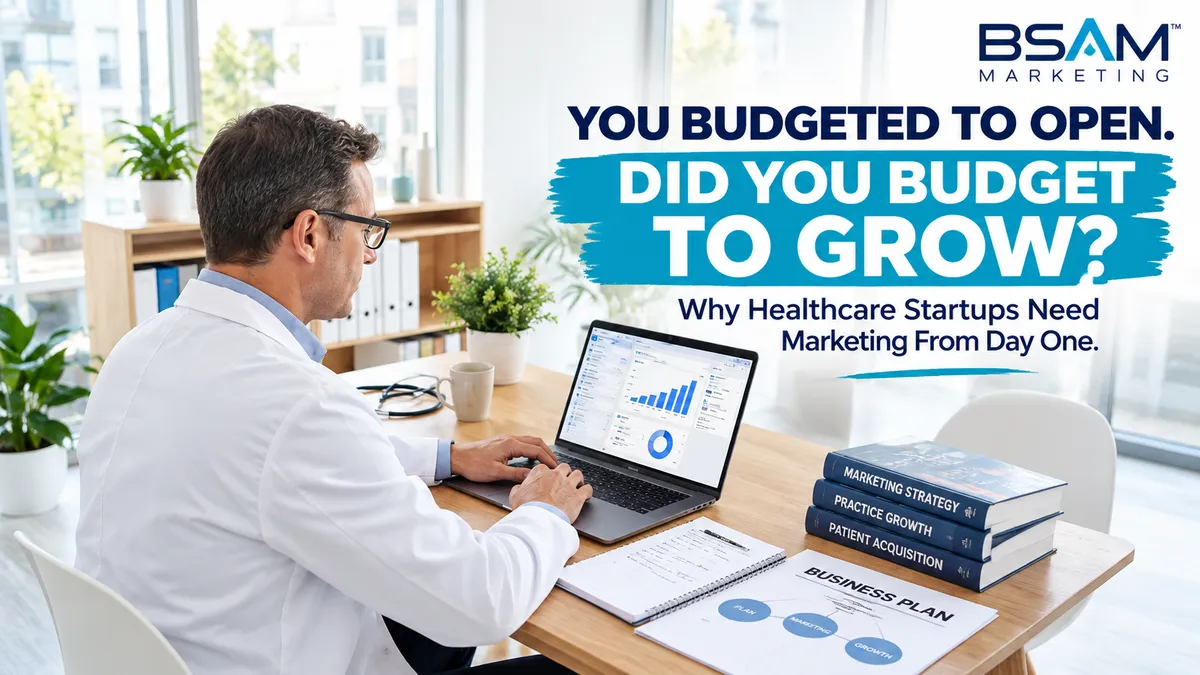
Healthcare Startup Marketing: Budget to Open AND Grow | BSAM Marketing
Opening Your Doors Is an Accomplishment. Filling Your Calendar Is Another Challenge.
In the next few weeks, we will be starting a series called “Invest Before You Open” to provide insights on how valuable marketing upfront can propel your business in the right direction faster.
Imagine this.
You've spent months, maybe even years, preparing to open your dream healthcare business.
You've secured financing, signed a lease, purchased equipment, obtained the necessary licenses, hired your team, and created a beautiful space where you're excited to welcome patients.
Opening day finally arrives.
But there's one thing you may not have fully prepared for.
How are people actually going to find your new business?
This is a question every healthcare entrepreneur should address long before opening day.
Whether you're launching an independent pharmacy, dental office, medical practice, medspa, chiropractic clinic, physical therapy center, or wellness business, getting established requires more than securing a location and purchasing equipment.
It requires a strategy for consistently introducing your services to the community.
Unfortunately, marketing is often one of the first things new business owners postpone when startup expenses begin adding up.
At BSAM Marketing, we encourage healthcare entrepreneurs to consider a different approach:
Don't just budget to open your business. Budget to help it grow.
1. The Startup Expense That Often Gets Pushed to the Bottom of the List
Let's look at a typical healthcare startup checklist.
Depending on your business model, you may need to account for:
Commercial space, deposits, and renovations.
Medical equipment and technology.
Licensing, legal services, and insurance.
Initial inventory and supplies.
Staffing, training, and payroll.
Practice management software.
Utilities and ongoing operational expenses.
Working capital for the early months.
These are legitimate and necessary investments.
But where does marketing fit into that equation?
The U.S. Small Business Administration (SBA) includes advertising, marketing, market research, and website development among the expenses entrepreneurs should consider when calculating startup costs.
In other words, planning how customers will discover your business is part of preparing to launch it.
Yet many new healthcare entrepreneurs approach marketing as something they'll address after they begin generating revenue.
The challenge with that strategy is that revenue generally requires patients or customers first.
And those patients need to know you exist.
Your business can be fully equipped and operational without being visible to the people searching for your services.
Reference: U.S. Small Business Administration — Calculate Your Startup Costs (sba.gov).
2. Is a $50K or $100K Startup Investment Realistic?
Healthcare startup costs vary significantly depending on the type of business being established.
A solo wellness professional launching a lean operation will have different financial requirements from an independent pharmacy, a dental office, or a fully equipped medical practice.
For example, consider three hypothetical financing scenarios:
Startup Scenario | Illustrative Financing |
Lean healthcare or wellness startup | $50,000 |
Small healthcare practice startup | $100,000 |
Equipment-intensive medical business | $250,000+ |
These amounts are examples for financial planning discussions, not industry averages or recommendations for how much a business should borrow. Actual startup costs may be substantially higher, and total project financing may include owner equity in addition to loans.
Regardless of the amount invested, the underlying question remains the same:
How much of that capital have you allocated toward making potential patients aware of your business?
Let's use a hypothetical $100,000 startup financing scenario.
If nearly every dollar is committed to equipment, office space, furniture, staffing, and supplies, what happens when you open and discover you have little remaining to invest in attracting patients?
You may find yourself trying to generate business without a dedicated marketing budget, while your fixed expenses and loan payments continue.
That doesn't mean you should redirect essential operating funds toward advertising.
It means patient acquisition needs to be considered during the initial planning process, alongside realistic cash reserves and operating requirements.
3. "I'll Just Rely on Referrals Until I Get Established."
This is one of the most understandable approaches new healthcare entrepreneurs consider.
You may plan to:
Introduce yourself to other healthcare providers.
Attend networking events.
Rent a table at local health fairs.
Distribute business cards and brochures.
Ask family and friends to spread the word.
Join local Facebook groups.
Build relationships with neighboring businesses.
And you absolutely should explore appropriate community-building opportunities.
Referrals and local partnerships can be extremely valuable, particularly in healthcare, where trust plays such an important role.
However, relying exclusively on referrals creates a challenge: you cannot always predict when the next referral will arrive.
Community events also require time, preparation, and sometimes substantial participation fees, without guaranteeing immediate appointments.
Meanwhile, potential patients may already be searching online for the services you offer.
Someone looking for a new dentist, chiropractor, pharmacy, physical therapist, or medspa may begin with Google rather than waiting for a personal recommendation.
If your business has little or no digital presence, those potential customers may never discover you.
A more complete strategy combines relationship-building with consistent digital visibility.
Think of referrals and community outreach as important parts of your growth strategy—not the entire strategy.
4. Should You Invest in Paid Advertising When You're Just Starting Out?
For some healthcare startups, paid advertising can be a useful way to introduce a new business to its local market.
Unlike organic marketing, which often requires time to develop, paid campaigns allow businesses to test targeted messaging and reach relevant audiences within a defined budget.
For example:
Google Search Ads: Reach people actively searching for services in your area.
Local Facebook and Instagram Ads: Introduce your practice, team, location, and available services to appropriate audiences.
Service-Specific Campaigns: Highlight particular offerings, provided the advertising complies with applicable healthcare, platform, and professional requirements.
However, there's an important distinction between spending money on ads and investing in an effective marketing strategy.
Before launching advertising, ask yourself:
Is my website professional and easy to navigate?
Can people quickly understand what services I provide?
Is my Google Business Profile established?
Is there a convenient way to request an appointment?
Who responds when a new inquiry arrives?
How will I know whether advertising generates actual patients?
Do I have the financial reserves to test campaigns responsibly?
Driving traffic to a website that isn't ready to convert visitors into inquiries can waste valuable startup capital.
That's why your digital foundation and follow-up systems should be established before aggressively increasing advertising spend.
Start with a manageable test budget. Evaluate the results. Adjust your approach based on actual performance.
5. What Does Marketing ROI Actually Mean for a New Practice?
Let's consider a simplified advertising example.
Suppose a new healthcare business tests $3,000 in monthly paid advertising.
For illustration, assume the campaign generates 100 qualified inquiries, and 30 of those inquiries become paying patients.
If each new patient generates an average of $250 in collected first-visit revenue, the campaign produces $7,500 in initial revenue.
Performance Metric | Hypothetical Result |
Advertising spend | $3,000 |
Qualified inquiries | 100 |
Cost per inquiry | $30 |
New paying patients | 30 |
Advertising cost per acquired patient | $100 |
First-visit collected revenue | $7,500 |
Revenue-to-ad-spend multiple | 2.5x |
Does that mean the business made $4,500 in profit?
Not necessarily.
The calculation must also consider agency fees, staffing, service delivery, overhead, financing costs, and other expenses.
Additionally, actual advertising performance varies based on specialty, competition, geographic location, campaign quality, and the business's ability to convert inquiries into paying patients.
The important takeaway is that marketing should be measured.
Instead of asking only, "How much did we spend on ads?" ask:
How much did we spend to acquire a new patient, and what financial contribution did that patient generate?
We'll explore this in greater detail in Week 2, including how a startup with $50K versus $100K in financing might approach marketing allocations differently.
6. The Reality of Trying to Do All Your Marketing Yourself
Here's another situation we frequently see among newer business owners.
After investing so much money into opening their practices, they decide to save on marketing expenses by managing everything themselves.
Initially, that may sound reasonable.
But consider what's involved in establishing a complete digital marketing presence.
You may need to:
Develop and maintain your website.
Optimize your Google Business Profile.
Research local SEO keywords.
Create blogs and social media content.
Design graphics.
Set up Google and Meta advertising campaigns.
Manage advertising budgets.
Monitor website traffic and conversions.
Build email and SMS workflows.
Respond to reviews.
Manage your CRM.
Analyze monthly marketing performance.
Now add all of that to your responsibilities as a healthcare business owner.
You're already managing operations, employees, patient care, administrative responsibilities, and the financial realities of running a new business.
Something eventually competes for your attention.
DIY marketing can work for entrepreneurs who have the necessary expertise and time.
However, it isn't automatically the most economical option.
Your time is valuable, too.
Every hour spent troubleshooting an advertising campaign is an hour unavailable for another part of your business.
7. What If You Could Subcontract the Marketing Work to an Agency Like BSAM?
This is where having an experienced marketing partner can change the way you approach your startup.
Rather than hiring multiple freelancers or trying to learn every marketing platform yourself, you can work with an agency to coordinate your digital strategy.
At BSAM Marketing, our goal is to help healthcare entrepreneurs develop a connected marketing approach that supports their business objectives.
Depending on the services selected, this can include:
Digital Foundation: Branding, website development, local SEO, and Google Business Profile optimization.
Marketing and Advertising: Targeted campaigns, content development, social media management, and ongoing optimization.
CRM and Automation: Organized lead management, inquiry tracking, and appropriate automated communication workflows.
Performance Monitoring: Helping owners understand where inquiries originate, how campaigns perform, and where adjustments may be needed.
Instead of spending your evenings figuring out how to run Google Ads or connect your appointment system to your CRM, you have a dedicated marketing resource managing the agreed-upon work.
That doesn't mean an agency can guarantee patient volume or remove every operational responsibility.
It means you don't have to build and manage an entire marketing department on your own.
8. Why Automation Shouldn't Be an Afterthought
Let's say someone discovers your practice online after business hours.
They submit an inquiry requesting information about an appointment.
What happens next?
If nobody checks the inbox until the following afternoon, that potential patient may have already contacted another provider.
Now imagine having a properly configured system that immediately acknowledges the inquiry, provides general next steps, and notifies your team.
This is one example of how automation can support a growing healthcare business.
Other opportunities include:
Appointment-request notifications.
Missed-call acknowledgment.
General inquiry follow-up.
Appointment confirmations.
Lead tracking and reporting.
Appropriate review-request workflows.
Healthcare automation must be designed with patient privacy, communication consent, and applicable regulations in mind, including HIPAA where relevant.
The objective isn't to replace human interaction.
It's to reduce unnecessary administrative work and help your team respond more consistently.
And establishing these systems early may be easier than trying to rebuild disconnected processes after your business has grown.
Reference: U.S. Department of Health and Human Services — HIPAA Privacy Rule and Marketing (hhs.gov).
9. Start With a Strategy, Not an Unlimited Marketing Budget
Investing in marketing upfront does not mean you need to spend thousands of dollars immediately or commit to every available marketing service.
A phased approach can be more practical.
Before Opening: Establish your branding, website, Google Business Profile, appointment-request process, and basic CRM infrastructure.
First 30 Days: Introduce your business to the local market, launch controlled advertising tests when financially appropriate, and begin consistent content marketing.
Days 31–60: Evaluate inquiry quality, campaign performance, booked appointments, and actual patient acquisition costs.
Days 61–90: Refine your strategy, strengthen follow-up systems, and consider expanding campaigns that demonstrate sustainable results.
Most importantly, protect sufficient working capital to cover your essential business expenses.
Your marketing budget should support your financial plan, not put it at risk.
Final Thoughts: Don't Just Invest in Opening Your Business. Invest in Helping People Find It.
Opening a healthcare business represents an enormous personal, professional, and financial commitment.
You've invested in your credentials, your location, your equipment, and your vision.
But remember: Your future patients need a way to discover everything you've worked so hard to create.
Referrals are important. Community relationships matter. Networking can be valuable.
Yet combining those efforts with digital marketing and automation gives your business a more structured approach to building awareness, responding to inquiries, and measuring growth.
Whether you're launching with $50K, $100K, or a substantially larger investment, marketing deserves a place in the conversation before opening day.
And you don't have to figure it all out yourself.
At BSAM Marketing, we work with healthcare entrepreneurs to coordinate their digital marketing and automation strategies so they can focus on what inspired them to open their businesses in the first place.
Ready to create a marketing strategy that makes sense for your startup budget?
Book your strategy session below and let's set you up to get a FREE competitor's analysis or a personal digital audit of your business! (valued @ $200):
https://api.leadconnectorhq.com/widget/bookings/discoverywithalicia
References and Additional Reading
U.S. Small Business Administration — Calculate Your Startup Costs: https://www.sba.gov/business-guide/plan-your-business/calculate-your-startup-costs
U.S. Small Business Administration — Plan Your Business: https://www.sba.gov/business-guide/plan-your-business
U.S. Department of Health and Human Services — HIPAA Privacy Rule and Marketing: https://www.hhs.gov/hipaa/for-professionals/privacy/guidance/marketing/index.html

Our Philosophy
Our focus is to bridge the gap between health and medical companies and the people who need them most, ensuring that medical expertise reaches the right audience with clarity and trust. We believe that impactful communication in healthcare should be precise, ethical, and patient-centered just like medicine itself. By combining innovation with integrity, we create digital strategies that not only enhance visibility but also foster meaningful connections, empowering health and medical professionals and businesses to serve, educate, and heal more effectively.
Get In Touch
Email: alicia@bsammarketing.com
Address:
2933 Vauxhall Road, Suite 7 Vauxhall, NJ 07088
Assistance Hours
Mon – Fri 10:00am – 4:00pm
Sat - Sun – CLOSED
Phone Number:
(201) 254-3338


MARKETING FOR THE HEALTH AND MEDICAL SECTORS
Helping Healthcare Professionals and Agencies, MedTech, HealthTech, Biotech and Pharmaceutical companies simplify and deliver their message, increase visibility and scale their businesses.



© 2026 BSAM Marketing - All Rights Reserved