
See Our Latest Blogs
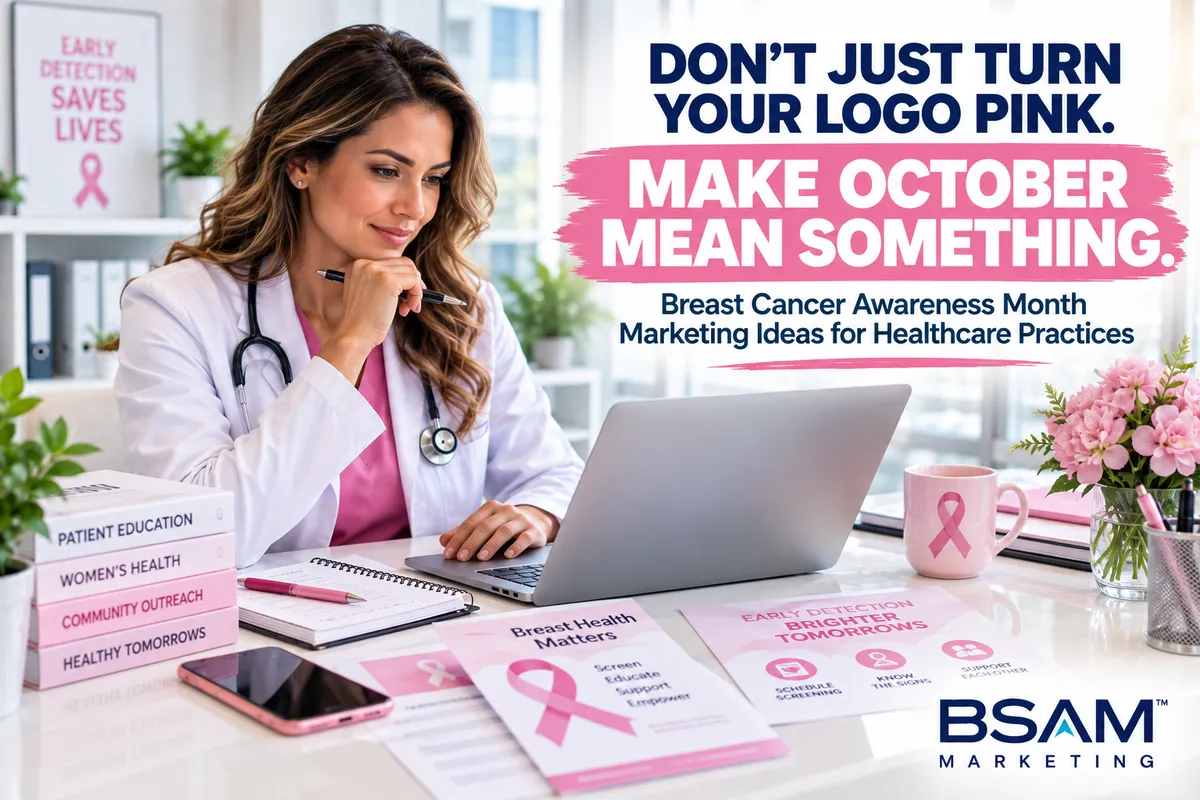
Breast Cancer Awareness Month: Marketing Ideas for Healthcare Practices
Don't Just Turn Your Logo Pink. Make October Mean Something.
Every October, healthcare organizations across the country turn pink.
Pink ribbons appear on social media.
Staff wear pink shirts.
Businesses change their profile pictures.
Waiting rooms display awareness materials.
Those gestures can certainly help keep breast cancer in the public conversation.
But healthcare organizations have an opportunity to do something more meaningful.
They can turn awareness into education, access, conversation, and action.
That's an important distinction.
Breast Cancer Awareness Month shouldn't simply become another entry on your healthcare marketing calendar.
Behind every pink ribbon are patients, survivors, caregivers, people undergoing treatment, people living with metastatic breast cancer, people grieving someone they've lost, and people anxiously awaiting test results.
So how can a medical practice, pharmacy, dental office, medspa, wellness center, physical therapy practice, or other healthcare business participate appropriately?
At BSAM Marketing, we'd encourage you to approach October with a simple principle:
Educate first. Support second. Promote yourself third.
Here's how.
1. Start With Accurate Breast Cancer Education
Before thinking about graphics, hashtags, giveaways, or events, determine what useful information your organization can help amplify.
The CDC notes that, other than skin cancer, breast cancer is the most common cancer among American women. Mammograms can identify breast cancer before it becomes large enough to feel or cause symptoms.
The current U.S. Preventive Services Task Force recommendation calls for biennial screening mammography for women ages 40 through 74 at average risk. The recommendation also applies to other people assigned female at birth who meet the criteria. People at higher risk may require different clinical guidance, so patients should discuss their individual risk and screening needs with an appropriate healthcare professional.
That's immediately useful content.
A healthcare organization could create posts answering questions such as:
When should I talk with my provider about mammography?
What factors can affect breast cancer risk?
What should I know about my family history?
What happens during a mammogram?
What breast changes should prompt a conversation with a clinician?
The CDC lists possible symptoms, including a new breast or underarm lump, changes in breast size or shape, breast pain, and nipple discharge other than breast milk, while noting that some people have no symptoms.
Your content doesn't need to diagnose anyone.
It can help people recognize when it's time to seek appropriate medical guidance.
2. Create a “Know Your Screening” Campaign
One of the easiest ways to turn awareness into action is to build a simple educational campaign around screening.
Instead of posting:
“October is Breast Cancer Awareness Month! 🎀”
and stopping there, build a sequence.
For example:
Week 1: Why breast cancer screening matters.
Week 2: Questions to ask your healthcare provider about your individual risk.
Week 3: What to expect during a mammogram.
Week 4: Don't let awareness end with October; make your health plan for the year ahead.
The USPSTF even provides a discussion resource intended to help healthcare professionals begin conversations about breast cancer screening with patients ages 40–74.
That's healthcare content marketing with an actual purpose.
3. Use Your Platform to Help Patients Find Screening Resources
Not every healthcare organization performs mammograms.
That's okay.
You can still help.
A pharmacy, primary care practice, physical therapy clinic, medspa, dentist, chiropractor, wellness practice, or other healthcare business can direct its community toward reputable screening resources.
For example, the CDC's National Breast and Cervical Cancer Early Detection Program helps provide access to free or low-cost mammograms for qualifying women who have low incomes and are uninsured or underinsured.
Consider creating a resource post such as:
“Need help finding affordable breast cancer screening? Start here.”
That kind of post may generate fewer promotional clicks than a discount offer.
But it may provide significantly more value to your community.
And that's exactly the point.
4. Partner With Another Local Healthcare Organization
Breast Cancer Awareness Month provides a natural opportunity for healthcare organizations to collaborate.
A primary care practice might partner with a local imaging center.
An independent pharmacy might collaborate with an oncology practice or community nonprofit.
A wellness center could host an educational session with an appropriate licensed healthcare professional.
A physical therapy practice might create educational content around rehabilitation and survivorship within its professional scope.
Rather than every organization independently saying:
“We're wearing pink!”
Imagine several healthcare organizations working together to create:
A Local Women's Health Resource Day
Depending on the participating organizations, the event might include:
Educational resources.
Screening information.
Community support resources.
Appropriate clinician Q&A.
Information about local mammography services.
Resources for caregivers.
That transforms awareness into community healthcare outreach.
5. Independent Pharmacies Have a Particularly Strong Opportunity
For our pharmacy clients and readers, October creates several possibilities.
Independent pharmacies are often deeply embedded within their communities.
Your pharmacists see patients regularly.
That makes the pharmacy a natural place to distribute reputable educational resources.
Consider:
A Breast Health Resource Station
Create a tasteful area containing credible information about screening, risk conversations, and local resources.
Bag Inserts
Include a small educational insert directing customers to reputable breast cancer resources.
Digital Screens
If your pharmacy uses in-store digital displays, dedicate appropriate space to awareness and screening education.
Community Partnership
Partner with a local imaging center, women's health provider, cancer support organization, or other appropriate organization.
Social Education
Use your pharmacy's social channels to share credible resources rather than simply promotional posts.
The pharmacy doesn't need to become an oncology center.
It can become a trusted connector to reliable information.
6. Highlight Your Team, But Give the Post a Purpose
Staff photos can work extremely well during awareness campaigns.
But instead of simply posting:
“Our team is wearing pink today! 🎀”
add something useful.
For example:
“Our team is wearing pink today to support Breast Cancer Awareness Month, and we're using the opportunity to remind our community that conversations about breast cancer screening shouldn't stop when October ends.”
Then direct readers toward credible information.
You can still show personality.
You can still build community.
But the post becomes about something larger than your brand.
7. Tell Stories Carefully
Stories can be incredibly powerful.
They can also be deeply personal.
If a staff member, patient, survivor, caregiver, or community member chooses to share their breast cancer experience, their story may help someone else feel less alone.
But healthcare organizations need to approach patient stories particularly carefully.
Never assume someone's medical story is marketing content.
Obtain appropriate written permissions and follow applicable privacy requirements before using patient information, images, testimonials, or health-related stories.
And don't pressure survivors to become the face of an October campaign.
Participation should be voluntary, respectful, and appropriately documented.
Sometimes the strongest story isn't:
“Look at our organization.”
It's:
“Here's what someone in our community wants others to know.”
8. Don't Forget Metastatic Breast Cancer
Breast Cancer Awareness Month can sometimes become dominated by upbeat pink imagery.
That can unintentionally leave some people feeling unseen.
National Breast Cancer Foundation identifies October 13 as Metastatic Breast Cancer Awareness Day, recognizing people living with Stage 4 metastatic breast cancer.
Consider dedicating a post to metastatic breast cancer and support resources.
This is also a reminder to be thoughtful with phrases such as:
“Fight like a girl.”
“Beat cancer.”
“Stay positive.”
Cancer outcomes aren't a reflection of someone's positivity, strength, or determination.
Compassionate healthcare communication leaves room for every experience.
9. Remember That Breast Cancer Doesn't Affect Only Women
Breast cancer is overwhelmingly associated with women, but men can develop breast cancer too.
National Breast Cancer Foundation's 2026 awareness calendar identifies October 17–23 as Men's Breast Cancer Awareness Week.
That gives healthcare organizations another valuable educational opportunity.
A simple post such as:
“Breast cancer isn't exclusively a women's health issue.”
can help address an awareness gap.
Your messaging can remain primarily relevant to the population most affected while acknowledging that breast cancer can affect others.
10. Create an October Content Calendar
You don't need to mention breast cancer every day.
A focused series can be more effective.
Week | Content Theme | Example |
Week 1 | Awareness | What Breast Cancer Awareness Month is really about |
Week 2 | Education | Screening and conversations about individual risk |
Week 3 | Community | Local screening/support resources |
Week 4 | Action | What will you do after October ends? |
You can repurpose each theme across:
Facebook.
Instagram.
LinkedIn.
Google Business Profile.
Email.
Waiting-room screens.
Website/blog content.
Printed materials.
One well-researched educational article can become multiple pieces of useful content.
That's exactly how healthcare content marketing becomes more efficient.
11. Consider a Community Fundraiser, But Be Transparent
If your practice wants to raise money during October, wonderful.
Just make the details clear.
Tell people:
Which organization is receiving the donation?
What percentage or dollar amount is being donated?
What dates does the campaign cover?
Does someone need to purchase something for a donation to occur?
Is there a maximum contribution?
Avoid vague statements such as:
“A portion of proceeds supports breast cancer awareness.”
Specificity builds trust.
Before associating your business with a nonprofit's name, trademarks, fundraising campaign, or promotional materials, confirm the organization's requirements and obtain permission when necessary.
12. What Healthcare Practices Should Avoid During October
This may be the most important marketing section.
Breast Cancer Awareness Month is not an excuse to attach a pink ribbon to every promotion.
Be cautious about:
Overly promotional messaging
“Breast Cancer Awareness Month Special — 20% OFF!”
Depending on the service, that can feel disconnected or exploitative.
Fear-based marketing
Don't frighten people into appointments.
Unqualified medical claims
Keep educational information evidence-based and within your professional scope.
Patient stories without proper authorization
Privacy doesn't disappear because the story supports a good cause.
Performative awareness
If your campaign is entirely about your logo turning pink, ask what value you're actually giving the community.
Using cancer primarily to generate engagement
A serious diagnosis shouldn't become clickbait.
The question to ask before publishing is:
“Does this help someone—or does it mostly help us?”
13. Don't Ignore Health Disparities
Breast cancer awareness also provides an opportunity to discuss access and disparities responsibly.
The USPSTF notes substantial inequities in breast cancer outcomes. Its current recommendation states that Black women are approximately 40% more likely to die from breast cancer than White women, despite breast cancer incidence not being dramatically higher.
That's an important healthcare conversation.
Practices serving diverse communities can use October to highlight:
Access to screening.
Language-accessible resources.
Transportation resources.
Insurance and low-cost screening information.
Culturally relevant education.
Local community organizations.
Awareness should include people who face barriers to turning awareness into care.
14. Use October to Build Something That Lasts Past October
Here's where BSAM's marketing philosophy comes into the picture.
Don't create four breast cancer posts, publish them in October, and forget about the topic on November 1.
Create evergreen resources.
For example:
“Breast Cancer Screening Resources in [Your City]”
“Questions to Ask Your Provider About Breast Cancer Risk”
“Where to Find Low-Cost Mammography Resources”
“Understanding Breast Cancer Screening Recommendations”
These can live on your website and continue helping people throughout the year.
Your October campaign can therefore contribute to:
Patient education.
Local SEO.
Community visibility.
Healthcare partnerships.
Website content.
Email education.
Social media.
And most importantly, access to useful information.
That's much more powerful than temporarily turning your website pink.
15. How BSAM Can Help Healthcare Practices Build Meaningful Awareness Campaigns
Healthcare marketing around awareness months requires balance.
You want your organization to participate.
You want people to see the content.
You may want to support your community.
And yes, visibility is still part of marketing.
But healthcare businesses also have responsibilities that ordinary brands don't.
That's where strategy matters.
BSAM Marketing can help healthcare organizations develop coordinated awareness campaigns involving:
STRATEGY
Choosing messages appropriate for your audience and organization.
CONTENT
Blogs, social posts, educational campaigns, graphics, and email content.
LOCAL MARKETING
Google Business Profile posts and community-focused visibility.
PARTNERSHIPS
Campaign ideas involving appropriate local organizations.
AUTOMATION
Coordinating appropriate campaign communications and workflows.
REPURPOSING
Turning one strong educational resource into content across multiple channels.
The goal isn't simply to make your practice visible during October.
It's to make that visibility useful.
Final Thoughts: Awareness Is Stronger When It Leads Somewhere
A pink ribbon can start a conversation.
But the conversation shouldn't end there.
Breast Cancer Awareness Month gives healthcare organizations an opportunity to encourage education, conversations about individual risk, appropriate screening, community support, and access to credible resources.
So this October, don't ask only:
“What should we post for Breast Cancer Awareness Month?”
Ask:
“What can our organization do this month that might genuinely help someone?”
Maybe it's connecting someone with an affordable screening resource.
Maybe it's answering a question they've been afraid to ask.
Maybe it's introducing them to a local organization.
Maybe it's reminding someone to discuss screening with their healthcare professional.
Maybe it's simply making a patient or survivor feel seen.
That's healthcare marketing with purpose.
And that's the kind of marketing people remember.
Want Help Planning Your Healthcare Awareness Campaigns?
BSAM Marketing helps healthcare businesses turn health observances, patient education, community involvement, and digital marketing into coordinated strategies—without leaving your team scrambling to create content at the last minute.
Book your strategy session below and let's set you up to get a FREE competitor's analysis or a personal digital audit of your business! (valued @ $200):
https://api.leadconnectorhq.com/widget/bookings/discoverywithalicia
References & Resources
The current USPSTF recommendation calls for biennial mammography for average-risk women ages 40–74; individual circumstances can require different guidance.
U.S. Preventive Services Task Force — Breast Cancer Screening: https://www.uspreventiveservicestaskforce.org/uspstf/recommendation/breast-cancer-screening
CDC — Breast Cancer Awareness & Screening Resources: https://www.cdc.gov/cancer/features/breast-cancer.html
National Breast Cancer Foundation — Breast Cancer Awareness Month 2026: https://www.nationalbreastcancer.org/breast-cancer-awareness-month/
This article is intended for healthcare marketing education and is not medical or legal advice. Organizations should verify clinical information and follow applicable privacy, advertising, fundraising, professional, and patient-communication requirements.

Our Philosophy
Our focus is to bridge the gap between health and medical companies and the people who need them most, ensuring that medical expertise reaches the right audience with clarity and trust. We believe that impactful communication in healthcare should be precise, ethical, and patient-centered just like medicine itself. By combining innovation with integrity, we create digital strategies that not only enhance visibility but also foster meaningful connections, empowering health and medical professionals and businesses to serve, educate, and heal more effectively.
Get In Touch
Email: alicia@bsammarketing.com
Address:
2933 Vauxhall Road, Suite 7 Vauxhall, NJ 07088
Assistance Hours
Mon – Fri 10:00am – 4:00pm
Sat - Sun – CLOSED
Phone Number:
(201) 254-3338

MARKETING FOR THE HEALTH AND MEDICAL SECTORS
Helping Healthcare Professionals and Agencies, MedTech, HealthTech, Biotech and Pharmaceutical companies simplify and deliver their message, increase visibility and scale their businesses.


© 2026 BSAM Marketing - All Rights Reserved